

Did you know that the foundation of your child’s intelligence, focus, and emotional well-being begins long before birth? Omega-3 fatty acids, especially DHA, play a powerful and irreplaceable role in shaping a baby’s brain and vision during pregnancy and early childhood. Scientific research increasingly confirms that these nutrients are essential for healthy neurological development and long-term cognitive performance. In this article, we explore how omega-3s support the growing brain and why ensuring an adequate supply from the very start is one of the most important decisions for your child’s future.
Omega-3 fatty acids, particularly docosahexaenoic acid (DHA), play a fundamental role in the development of the human brain and vision. Adequate levels of these fatty acids in both the mother and child are crucial for the proper functioning of the nervous and sensory systems, especially during fetal development and the first years of life.
The Role of DHA in the Brain – Mechanism of Action
DHA accounts for approximately 40% of all polyunsaturated fatty acids in the brain and around 60% in the retina. As a primary component of the phospholipids that make up neuronal cell membranes, DHA ensures membrane fluidity, flexibility, and structural integrity. These properties directly influence neural conductivity and the efficiency of communication between neurons.
DHA also plays a vital role in neurogenesis (the creation of new neurons), synaptogenesis (the formation of connections between neurons), and the modulation of inflammatory processes in the brain. Additionally, it affects the expression of genes responsible for neuronal differentiation and dendrite growth, which directly supports a child’s cognitive skills, attention span, and memory.
Importance During Fetal Development
In the third trimester of pregnancy (between weeks 29 and 40), the fetus’s need for DHA increases significantly. During this period, DHA is actively transported from the mother’s bloodstream through the placenta to the developing fetal brain and retina. It is estimated that DHA accumulates in the fetal brain at a rate of approximately 70 mg per day, making a key contribution to the formation of structures responsible for higher cognitive functions.
Insufficient DHA intake during pregnancy may lead to developmental delays, reduced cognitive function, and impaired visual acuity in the child. Numerous epidemiological studies have shown that children of mothers who consumed adequate amounts of DHA (e.g., from fatty marine fish or supplements) during pregnancy scored higher on intelligence tests, developed neurologically at a faster rate, and had better visual acuity.
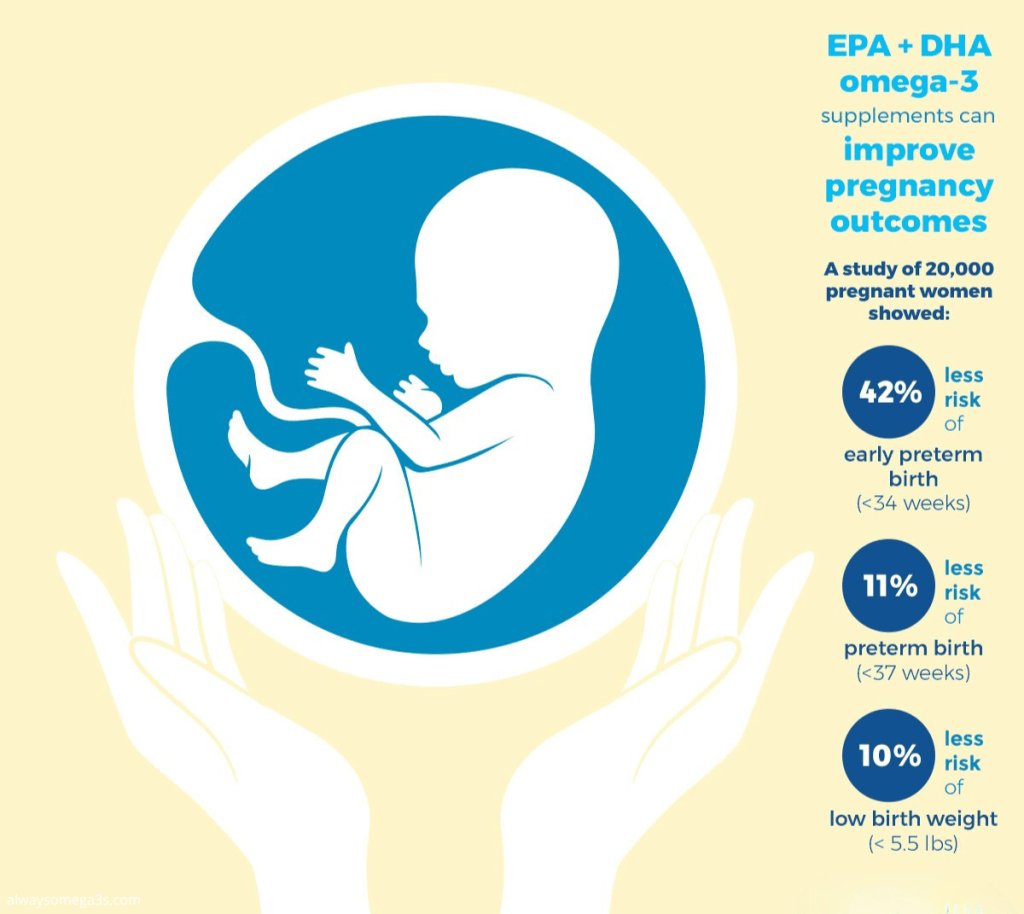
Furthermore, omega-3 supplementation during pregnancy reduces the risk of preterm birth by about 11%, and even more significantly in the case of very early preterm birth (before 34 weeks). One study involving 232 women with a history of preterm delivery found that fish oil supplementation lowered the risk of recurrence from 33% to 21%.
Importance During Infancy and Early Childhood
After birth, a child’s demand for DHA remains high—in fact, it increases. During the first two years of life, the brain reaches about 80% of its final size. DHA is primarily supplied through breast milk or DHA-fortified infant formulas. Infants breastfed by mothers with high DHA levels show improved cognitive performance, faster language development, better visual-motor coordination, and greater resistance to infections—likely due to DHA’s anti-inflammatory effects.
This is supported by a randomized controlled trial, which found that 9-month-old infants whose mothers consumed DHA-enriched functional foods during pregnancy performed better on problem-solving tasks compared to those in the control group.
Long-Term Benefits
Thanks to its effects on membrane structure and synaptic function, DHA supports the optimal development of the nervous system. A deficiency can impair the activity of microglia—cells responsible for shaping and refining neural connections during brain development. Such disruptions can have long-term consequences.
Children with adequate DHA levels more often achieve better academic performance, demonstrate stronger concentration, and show lower impulsivity. DHA may also reduce the risk of developing neuropsychiatric disorders such as ADHD, dyslexia, or depression. Increasingly, studies suggest that children with higher DHA levels in their systems perform better in school environments, showing enhanced focus, improved visual-motor coordination, and reduced impulsivity.
Recommendations and Safety
Experts recommend a daily intake of 200 to 600 mg of DHA during pregnancy and breastfeeding, with supplementation ideally beginning before the 20th week of pregnancy. Safe sources of DHA include fatty marine fish (such as salmon, mackerel, and sardines), fish oil, and high-quality dietary supplements.
Conclusion
Maintaining optimal levels of omega-3 fatty acids, especially DHA, in both the mother and child is essential for healthy brain and vision development. DHA-rich diets and supplementation support neurogenesis, the development of cognitive and visual functions, and help prevent developmental disorders. This makes omega-3 intake a highly effective preventive strategy that lays a strong foundation for a child’s neurological and psychological well-being throughout life.
Get acquainted with the products we recommend that support health and well-being
References
- Innis, S. M. (2007). Dietary (n-3) fatty acids and brain development. The Journal of Nutrition, 137(4), 855–859.
- Greenberg, J. A., Bell, S. J., & Van Ausdal, W. (2008). Omega-3 fatty acid supplementation during pregnancy. Reviews in Obstetrics and Gynecology, 1(4), 162–169.
- Makrides, M., Smithers, L. G., & Gibson, R. A. (2010). Role of long-chain polyunsaturated fatty acids in neurodevelopment and growth. Nestle Nutrition Workshop Series: Pediatric Program, 65, 123–133.
- Guesnet, P., & Alessandri, J. M. (2011). DHA and the developing CNS – Implications for dietary recommendations. Biochimie, 93(1), 7–12.
- Jensen, C. L., Voigt, R. G., Llorente, A. M., et al. (2005). Effects of maternal DHA supplementation on neurodevelopment of breastfed infants. The American Journal of Clinical Nutrition, 82(1), 125–132.
- Middleton, P., Gomersall, J. C., Gould, J. F., Shepherd, E., Olsen, S. F., & Makrides, M. (2018). Omega-3 fatty acid addition during pregnancy. Cochrane Database of Systematic Reviews, 11, CD003402.
- Hibbeln, J. R., & Davis, J. M. (2021). Impact of omega-3 fatty acid DHA and EPA supplementation in pregnancy on neurodevelopment. Nutrition Reviews, 79(6), 651–671.
- Gustafson, K. M., Colombo, J., & Carlson, S. E. (2016). Prenatal DHA supplementation and infant attention. Pediatric Research, 79(5), 656–662.
- Carlson, S. E., Colombo, J., & Gajewski, B. J. (2013). DHA supplementation and pregnancy outcomes. The American Journal of Clinical Nutrition, 97(4), 808–815.
- Olsen, S. F., Secher, N. J., & Tabor, A. (2000). Randomised clinical trials of fish oil supplementation in high-risk pregnancies. BJOG: An International Journal of Obstetrics & Gynaecology, 107(3), 382–395.
- Chen, B., Ji, X., & Zhang, L. (2022). Association between omega-3 fatty acid supplementation and lower risk of preterm birth. Journal of Maternal-Fetal & Neonatal Medicine, 35(15), 2922–2928.
- Lauritzen, L., Brambilla, P., & Mazzocchi, A. (2022). Omega-3 fatty acids and cognitive development: A systematic review. Nutrients, 14(22), 4899.
- Gustafson, K. M., Colombo, J., & Carlson, S. E. (2013). Effects of docosahexaenoic acid supplementation during pregnancy on fetal autonomic control. The American Journal of Clinical Nutrition, 97(4), 836–843.
- Makrides, M., Best, K., & Yelland, L. (2024). The role of omega-3 polyunsaturated fatty acids in the prevention of preterm birth. The Medical Journal of Australia, 220(10), 512–517.
- Markhus, M. W., Dahl, L., & Moe, V. (2022). Pregnant women’s diets and fatty acid intake. Journal of Environmental Health Sciences, 12(7), 58–67.
- Li, S., Zhao, Y., & Wang, J. (2021). Effects of n-3 polyunsaturated fatty acid supplementation on pregnancy outcomes. Archives of Medical Science, 17(5), 1415–1423.
- Innis, S. M. (2011). The role of omega-3 fatty acids in child development. OCL – Oilseeds and Fats, Crops and Lipids, 18(6), 307–314.