

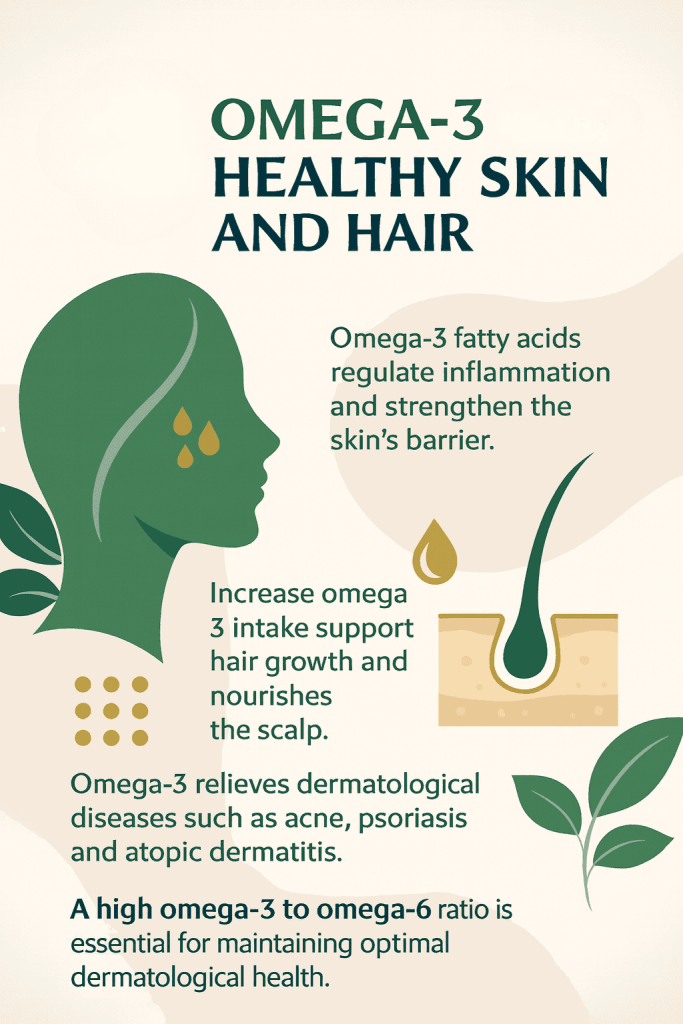
Healthy skin and strong hair are not solely the result of external care – they largely depend on what we provide our bodies from within. An increasing number of studies confirm that omega-3 fatty acids play a key role in maintaining skin balance and proper hair growth. Their anti-inflammatory properties help alleviate common dermatological issues such as acne, psoriasis, and atopic dermatitis. Omega-3 also supports the skin’s protective barrier and improves its hydration. It is therefore worth understanding how significantly they influence the appearance and health of both skin and hair.
As early as 1929, it was observed that a lack of fats in the diet leads to serious skin changes, such as dryness, flaking, and hair loss. Today, we know that EPA and DHA [LINK OLEJ]—the most important forms of omega-3—act at the cellular level and regulate inflammatory processes.
It is worth noting that a typical Western diet contains 15–20 times more omega-6 than omega-3. This imbalance promotes inflammation, while increasing omega-3 intake helps soothe the skin and support its barrier.
Omega-3 in Skin Conditions
Acne: Reducing Inflammation
Acne is an inflammatory condition, which is why omega-3 can significantly improve its course. Studies show that as many as 98% of people with acne are deficient in EPA and DHA.
Regular supplementation [LINK HEALTH PROTOCOL] improves skin appearance and reduces inflammation. Omega-3 lowers the production of cytokines and leukotrienes and helps regulate sebum secretion. As a result, the skin becomes less prone to clogged pores and the growth of Cutibacterium acnes bacteria.
Psoriasis: Fewer Lesions and Greater Comfort
In psoriasis, omega-3 also demonstrates strong effectiveness. Research shows that supplementation can reduce PASI scores, alleviate itching, and decrease erythema.
The best results are seen with doses exceeding 1800 mg of EPA/DHA [LINK OLEJ PREMIUM] per day. Omega-3 is converted into resolvins and protectins—molecules that actively resolve inflammation.
Atopic Dermatitis: Strengthening the Skin Barrier
In atopic dermatitis (AD), the integrity of the skin barrier is crucial. Omega-3 supports ceramide production and improves keratinocyte differentiation. Moreover, studies from 2025 show that higher omega-3 levels reduce the risk of AD by up to 38% in individuals with low genetic predisposition.
Regular supplementation [LINK OGÓLNY] also reduces the production of leukotriene B4, one of the key inflammatory molecules involved in AD.
Omega-6 to Omega-3 Ratio: A Key to Skin Health
The modern diet contains an excess of omega-6, which promotes the production of pro-inflammatory eicosanoids. Omega-3 works in the opposite way—supporting the formation of compounds with a much milder inflammatory effect.
The optimal omega-6 to omega-3 ratio is 3:1 to 5:1. Studies indicate that combining GLA (an omega-6 fatty acid) with omega-3 may provide the best results in reducing skin inflammation.
Omega-3 and Healthy Hair
Growth, Hydration, and Reduced Breakage
Omega-3 improves blood circulation in the scalp, which enhances the nourishment of hair follicles. As a result, hair grows faster and becomes stronger.
A deficiency of EPA and DHA can lead to dryness, dandruff, and breakage. Omega-3 may also extend the anagen phase, contributing to a fuller, denser hairstyle.
Research: Visible Results After 6 Months
A combination of omega-3 and omega-6 with antioxidants has been shown to improve hair density and reduce the percentage of hairs in the telogen phase in women experiencing hair loss.
A typical recommended dose is around 1000 mg of EPA + DHA per day to notice meaningful effects.
Practical Tips
To benefit from omega-3 for skin and hair health, include fatty fish (salmon, mackerel, sardines), flaxseeds, chia seeds, and walnuts in your diet. Supplementation—especially high-quality products [LINK OLEJ] containing EPA and DHA in effective doses—can accelerate improvements in skin and hair condition. Omega-3 supplementation offers many additional health benefits, making it worth starting or continuing high-quality omega-3 intake.
References
- Journal of Cosmetic Dermatology (2024). Omega-3 fatty acids in acne treatment.
- El Jbeily, R., et al. (2025). Review of Omega-3 Fatty Acid Dietary Supplementation in Dermatological Conditions. Journal of Integrative Dermatology.
- Study (2025). Association between omega-3 fatty acids and atopic dermatitis risk. UK Biobank data.
- Balić, A., et al. (2020). Omega-3 Versus Omega-6 Polyunsaturated Fatty Acids in the Prevention and Treatment of Inflammatory Skin Diseases. Nutrients, 9(1).
- Le Floc’h, C., et al. (2015). Effect of a nutritional supplement on hair loss in women. Journal of Cosmetic Dermatology, 14(1), 76-82.
- Linus Pauling Institute (2025). Essential Fatty Acids and Skin Health. Oregon State University.
- Calder, P.C. (2010). Omega-3 fatty acids and inflammatory processes. Nutrients, 2(3), 355–374.
- OmegaQuant (2025). Skin Benefits of Omega-3s.
- Kim B.R. i wsp. Causal association between polyunsaturated fatty acids and acne: a two-sample Mendelian randomization study.
- Niseteo T. i wsp. Effect of Omega-3 Polyunsaturated Fatty Acid Supplementation on Clinical Outcome of Atopic Dermatitis in Children.
- Balić A. i wsp. Omega-3 versus omega-6 polyunsaturated fatty acids in the prevention and treatment of inflammatory skin diseases
- Le Floc’h C. i wsp. Effect of a nutritional supplement on hair loss in women.