

Have you ever wondered how something as simple as healthy fats could transform your health from the inside out? In fact, omega-3 fatty acids—often praised for their heart benefits—are now gaining attention as powerful natural allies in the fight against chronic inflammation. Backed by groundbreaking research from the United States, these essential nutrients may hold the key to preventing many of today’s most common diseases. In this article, you’ll discover how omega-3s work, what science says about their effects, and how you can make them a part of your daily routine for better health and vitality.
The Science Behind Omega-3 and Inflammation
In recent years, scientists in the United States have increasingly focused on the effects of omega-3 fatty acids on human health—and for good reason. Research shows that these healthy fats can effectively reduce chronic inflammation, which is one of the main contributing factors in the development of many lifestyle diseases, including diabetes, atherosclerosis, and autoimmune disorders. Consequently, maintaining adequate omega-3 levels can be a crucial step in preventing these conditions.
How Do Omega-3 Fatty Acids Work?
The two most important omega-3 fatty acids—EPA (eicosapentaenoic acid) and DHA (docosahexaenoic acid)—have strong anti-inflammatory properties. For instance, in a U.S.-based study, medical students took 2.5 grams of omega-3 daily for 12 weeks. As a result, levels of interleukin-6 (IL-6), a key inflammatory marker, dropped by 14%. Additionally, participants reported a 20% reduction in anxiety symptoms.
Interestingly, EPA and DHA affect the immune system in different ways. Comparative studies show that DHA has a broader anti-inflammatory effect, reducing the expression of four types of pro-inflammatory proteins, while EPA affects only one. In particular, DHA significantly lowers levels of TNF-α, IL-6, MCP1, and IL-10, suggesting it may have more potent anti-inflammatory action.
Effects on Key Inflammatory Markers
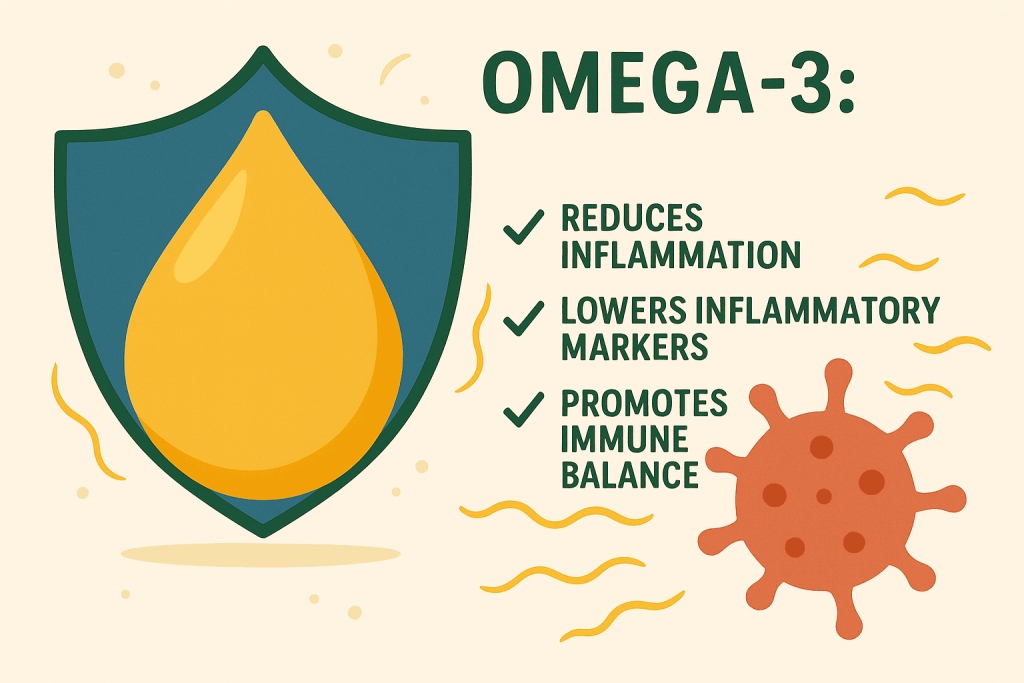
Furthermore, an analysis of 32 studies involving thousands of patients revealed that omega-3 supplementation significantly reduces three key inflammatory markers:
- C-reactive protein (CRP) – by 40%
- TNF-α – by 23%
- IL-6 – by 22%
These aren’t just numbers—they reflect a real impact on health. Indeed, these markers are essential indicators of inflammation in the body, and reducing them leads to better overall well-being. Moreover, positive effects of omega-3 have also been observed in COVID-19 patients, where supplementation helped lower CRP levels and ease the severity of the disease.
Resolvins – A Breakthrough Discovery
One of the most important discoveries in recent years has been the identification of resolvins—special molecules derived from omega-3s. Unlike typical anti-inflammatory agents, they don’t just stop inflammation; they help the body return to homeostasis, or balance. Therefore, resolvins show therapeutic potential in treating kidney and lung damage, as well as neurodegenerative diseases.
Practical Applications
According to the American Heart Association, a daily intake of about 3 grams of omega-3s helps maintain healthy blood pressure. In addition, for individuals with elevated triglyceride levels, a daily dose of 4 grams of EPA and DHA can lower triglycerides by 20–40%.
How Much Should You Take?
As mentioned earlier, the American Heart Association recommends 3 grams of omega-3 per day to support heart health and blood pressure. However, people with high triglycerides may benefit from up to 4 grams of EPA and DHA daily—a dose shown to reduce triglyceride levels by as much as 40%.
Moreover, research indicates that omega-3s are beneficial not only for people with health conditions but also for healthy individuals. For example, in patients recovering from a heart attack, taking 2 grams of omega-3s daily for 30 days led to a greater reduction in inflammatory markers (such as hs-CRP) compared to a placebo group.
Conclusion
In conclusion, omega-3 fatty acids are much more than just a trendy supplement. They are a genuine ally in the fight against chronic inflammation—one of the silent killers of modern life. By regularly consuming foods rich in EPA and DHA, and supplementing when necessary, you can significantly improve your health and overall well-being. Ultimately, as the latest studies show, giving omega-3s a chance is a smart move for long-term health.
Get acquainted with the products we recommend that support health and well-being
References
- Kiecolt-Glaser, J. K., Belury, M. A., Andridge, R., Malarkey, W. B., & Glaser, R. (2012). Omega-3 supplementation lowers inflammation and anxiety in medical students: A randomized controlled trial. Brain, Behavior, and Immunity, 26(7), 1097–1107.
- So, J., Jeong, Y., Yu, G., & Park, S. Y. (2021). EPA and DHA differentially modulate monocyte inflammatory response. Prostaglandins, Leukotrienes and Essential Fatty Acids, 169, 102281.
- Sedighiyan, M., Abdollahi, H., Karimi, M., et al. (2022). Effect of omega-3 fatty acids supplementation on serum level of C-reactive protein in COVID-19 patients: A randomized controlled trial. Journal of Translational Medicine, 20, 452.
- Serhan, C. N., & Levy, B. D. (2018). Resolvins in inflammation: Emergence of the pro-resolving superfamily of mediators. Journal of Clinical Investigation, 128(7), 2657–2669.
- Yaribeygi, H., Sathyapalan, T., Atkin, S. L., & Jamialahmadi, T. (2022). Efficacy of omega-3 fatty acids supplementation on inflammatory biomarkers: A systematic review and meta-analysis. Pharmacological Research, 178, 106156.
- Zheng, S., Monti, S., Pederiva, S., et al. (2020). Predicting resolvin D1 pharmacokinetics in humans from preclinical data. Frontiers in Pharmacology, 11, 730.
- Kris-Etherton, P. M., Harris, W. S., & Appel, L. J. (2003). Omega-3 fatty acids and cardiovascular disease: New recommendations from the American Heart Association. Circulation, 107(3), 274–276.
- Skulas-Ray, A. C., Wilson, P. W., Harris, W. S., et al. (2019). Omega-3 fatty acids for the management of hypertriglyceridemia: A science advisory from the American Heart Association. Circulation, 140(12), e673–e691.
- Darabi, B., Zangeneh, M., Shams, E., et al. (2024). Omega-3 fatty acids effectively mitigate high-sensitivity C-reactive protein levels in acute myocardial infarction patients: A randomized clinical trial. Clinical Nutrition ESPEN, 60, 465–471.
- American Heart Association. (2022, June 1). Consuming about 3 grams of omega-3 fatty acids a day may lower blood pressure.
- Amini, M. R., Rafraf, M., Mobasseri, M., Asghari-Jafarabadi, M., & Sadeghi-Bazargani, H. (2019). Omega-3 fatty acids effects on inflammatory biomarkers and lipid profiles in women with rheumatoid arthritis: A randomized, double-blind, placebo-controlled trial. Scientific Reports, 9, 7143.
- American Heart Association. (n.d.). Nutrition recommendations.